Showing posts with label wimax products. Show all posts

Sunday, December 28, 2008

EV-DO VS HSDPA VS WiMAX

With WiFi, laptop-toting road warriors were no longer tethered to cords for internet access. Cutting the cord, however, put the user at the mercy of finding a nearby Starbucks or other hotspot location, only partially providing the sense of freedom that users wanted. Eventually, cell phone companies realized providing high-speed data over cellular networks could be a major business boom, especially if the access could be relatively speedy. Now, we've got a few competing standards that can get you on the internet wirelessly, but there are a few gotchas with each standard. Read on as we break down the basics of wireless net access.

EV-DO

National providers
Sprint and Verizon Maximum throughput speed:

Rev 0: 2.4 Mbps download, 153 Kbps upload
Rev A: 3.1 Mbps download, 1.8 Mbps upload

Provider bandwidth caps 5GB download per month on both Sprint and Verizon.
Pricing: $59.99 / month for Sprint & Verizon

EV-DO was one of the first acceptable-speed mobile internet acecss methods, and its tried and true approach to 3G data works effectively. Rather than being offered as a sort of wired broadband replacement, the pricey services from Sprint and Verizon are seen as more of an office broadband augmented luxury rather than a way to replace the home DSL service to which users have grown accustomed. EV-DO gets the job done in the mobile broadband department, and currently its what I use when I'm on the road (although through a tethered phone). However, take note of the 5GB download cap per month. If you're planning to use this as your primary connection and are any sort of power user, 5GB gets eaten up pretty quickly.

HSDPA / UMTS / EDGE

Providers: AT&T and T-Mobile
Maximum throughput speed:
HSDPA: 3.6 Mbps dowload, 1.2 Mbps upload
UMTS: 700 Kbps download, 500 Kbps upload
EDGE: 384 Kbps download, 236 Kbps upload
Provider bandwidth caps: AT&T: 5GB
T-Mobile: nonePricing:
$60 for HSDPA / UMTS on AT&T

$49.99 for EDGE / HSDPA (coming soon) on T-Mobile


Though it's coming late to the game, 3G connection through AT&T and T-Mobile could end up being more appealing than EV-DO. The primary reason? Speed. EV-DO isn't seeing nearly as much speed increase as HSDPA and UMTS. However, the biggest problem with current implementations by AT&T and T-Mobile is that the network coverage is rather spotty. EV-DO access stretches nearly nationwide, and Sprint and Verizon have roaming agreements on each others' networks, meaning there are few EV-DO deadspots. HSDPA and UMTS, however, started rolling out slowly after EV-DO, and haven't yet caught up. In fact, T-Mobile literally just started rolling out its 3G network in August 2008, and its technology isn't cross compatible with AT&T's technology, due to some differences in implementation -- meaning T-Mobile and AT&T high-speed users can't roam on each other's networks for increased coverage.

HSDPA and UMTS are in their infancy still, so if you're in an area (or travelling frequently to an area) with good mobile broadband coverage with UMTS / HSDPA and are looking for higher speeds than EV-DO, it might be worth a look. However, do some coverage area research before plunking down the cash. Be aware that the 5GB download cap still applies, too.

WiMAX

Provider
Sprint XOHM
Maximum throughput speed:
5 Mbps download, 2.6 Mbps upload
Provider bandwidth caps:
No caps on bandwidth
Pricing:
$35 / month for "home"
$45 / month for "on the go"
$65 / month for combo
$10 / single day access

The least widespread but most exciting high-speed data technology is WiMAX. While currently it's only deployed using Sprint's XOHM network in Baltimore, this up and coming technology shows the most forward looking promise of any of the cellular data options. Currently, the throughput speeds are around 5 Mbps, but WiMAX has a forward looking approach that'll have higher speeds as the netowrk continues to be deployed. Remember those 5GB bandwidth caps of UMTS/ HSDPA and EV-DO? WiMAX doesn't have them. Sprint says the real story behind WiMAX is the capacity story, rather than the high-speed story, in that the architecture behind WiMAX allows providers to more efficiently manage the network, thereby allowing people to use it as their primary internet access method. Sprint's bargain basement pricing for the Baltimore-exclusive WiMAX rollout looks very inviting, however those of us outside of 'Monument City' will be stuck waiting for WiMAX rollouts nationwide over the next few years.

Other notes

Getting online with cellular data means you'll have to meet a couple of requirements. For starters, you'll have to have a semi-modern laptop that has at minimum a USB port, but most of the providers also offer solutions using ExpressCard. For PC users, that means you'll need to have a system that has either an available USB port or ExpressCard 34 slot (the skinny kind, pictured left). For Mac users, MacBooks only have USB ports, while the MacBook Pro has an ExpressCard 34 slot as well as a USB port.

Some laptops, like many in Sony's Vaio series, include built-in mobile broadband without having to plug in an external device. These notebooks will work with a specific network type, and you'll have to contact your provider to figure out how to sync up the laptop with the network.

Also, while we're mainly focusing on adding broadband to laptops, many of the service providers listed also offer some form of "tethering" to cell phones, meaning your phone turns into the modem. Often times these plans are less expensive than the plans we've outlined above, but you'll again have to check with your provider to see if your phone is compatible.

INTEL WIMAX CORE i7 CHIP

Intel senior vice president Anand Chandrasekher, speaking Monday at IDF, said that Intel will collaborate with Ericsson for High Speed Packet Access (HSPA) data modules for the Moorestown platform. WiMax is also supported, but it faces stiff competition from entrenched wireless technologies and may not be compelling enough to rise above the fray.

In addition to WiMax and HSPA, other wireless technologies including WiFi, GPS, Bluetooth, and mobile TV will be supported on Moorestown, Intel said.

Moorestown is a system-on-a-chip (SOC) comprised of "Lincroft," which integrates a 45-nanometer processor, graphics, memory controller, and video encode/decode onto a single chip. It also includes an "I/O hub" code-named Langwell that supports connection to wireless, storage, and display components.

Intel was also showing a number of slides that detail its upcoming Nehalem i7 processor and the accompanying X58 chipset. Intel said last week that Nehalem is shipping now and is due to be officially rolled out in November.

The i7 will initially appear as a quad-core processor and feature QuickPath Interconnect--a high-speed chip-to-chip communications technology--and "Turbo Boost," which had been referred to previously as "Turbo Mode." This is essentially a switch that turns off unused processor cores and then uses the remaining active cores more efficiently.

In Taipei, Intel also delineated the differences between Atom-based "Nettop" desktops and more mainstream desktop PCs. Intel is trying to promote Nettops for Web browsing, word processing, e-mail, and "legacy" games. Anything more taxing than these basic applications is not recommended for Nettops.

Intel Core i7 and x58 chipset features

Intel Core i7 and x58 chipset features.

(Credit: Intel)

Intel Atom-based Nettop desktop

Intel Atom-based Nettop desktop.

(Credit: Intel)

Friday, November 14, 2008

GLOBAL WIMAX EQUIPMENTS SALES


The WiMAX Research Service includes WiMAX licenses, trials and deployments by 530 companies in 134 countries. As of Q3 2008, we covered:

  • 126 commercially operating WiMAX networks
  • 112 WiMAX networks under construction
  • 91 WiMAX field trials
  • 193 WiMAX licensees
The WiMAX Research Service includes global WiMAX licenses, trials and deployments, by country and by service provider. For each trial and deployment, we track:
  • Operator
  • Frequency
  • Launch date
  • Technology (802.16-2004, 802.16-e)
  • Equipment vendor
  • Contract date
  • Network coverage
  • Subscribers
  • Equipment vendors
WiMAX Equipment Vendor Market Share (Oct 2008)


If you want more detailed information periodic you can order TeleGeography's quarterly WiMax Market Review.

Sunday, June 15, 2008

SPRINT: SAMSUNG WIMAX READY

Sprint and Samsung today declared Mobile WiMax ready for commercial service. Sprint plans on launching commercial WiMax in Washington and Baltimore “later this year”.

Washington and Baltimore joined Chicago in a “soft rollout”, in which Sprint workers use and test the technology, a Sprint spokesman said last week. A Clearwire Mobile WiMax rollout is also planned, likely later this summer, in Portland, Oregon.

Despite today’s announcement about Washington and Baltimore, no commercial rollout projection for Chicago was mentioned. When asked about Chicago, a Sprint spokesman said “there will be further progress to report at another time.”

It’s a Motorola party in Chicago and Portland.

Sprint and Samsung said testing of overall performance, including successful wireless handoffs between cell towers without delay, had met Sprint’s “rigorous commercial acceptance criteria.” Testing was conducted in laboratories, as well as in the Baltimore-Washington area, the companies said.

Samsung has been working with Sprint since June 2007. There were lab tests, followed by field tests in October and then interoperability tests with “multiple” other device vendors in April.

Those devices included a Nokia’s WiMax tablet, a Samsung WiMax express card for laptops and a Zyxel WiMax modem. Intel has been developing chip sets for use in laptops and ultramobile PCs.

Clearwire is planning to move onto Atlanta, Los Angeles, and Grand Rapids, Mich., with mobile WiMax deployments after it launches in Portland, Ore., in the second half of this year, the company said during its first quarter earnings call this week. Clearwire ended the first quarter of 2008 with 443,000 users, up 72 percent on the previous year’s first quarter.

Maravedis forecasts WiMAX subscribers to exceed 100 million by 2014.

Meanwhile, there are more than 45 million cellular-based HSPA users worldwide, delivering consistent data rates in the range of 500 kbit/s to 1.5 Mbit/s, reports Unstrung. The GSM family will account for fully 89% of the global market in 2011, according to Gartner Inc. In the U.S., AT&T is a GSM provider, along with T-Mobile, which many believe will eventually announce intentions to support LTE and has launched AWS service in New York City.

Alltel has committed to LTE but any significant network upgrades are still three to five years out, the company said today. The No. 5 carrier has just over 13 million customers. Alltel is the second major CDMA carrier (after Verizon Wireless) to switch tracks and select LTE. Sprint, of course, is going the Mobile WiMAX route (and may get a 3-5 year lead over the competition).

Late to the party, AT&T and Verizon had to pay a premium for their spectrum, will wait years for LTE infrastructure, and could be left with scraps for their microwave backhaul.

It’s what I call the elephant in the room that nobody talks about,” explained Clearwire CTO John Saw, to Unstrung. “The backhaul is probably the highest cost of deploying the network… Anyone who wants to roll out a real wireless broadband network nationwide needs a cheaper solution.”

Friday, April 11, 2008

SPRINT'S XOHM WIMAX SUPPORTED LAPTOP


Debuting today at CTIA 2008, the Cloudbook MAX not only boasts an 8.9-inch WVGA (1,024 x 600) display, Windows Vista, 802.11b/g WiFi, Bluetooth, integrated GPS receiver, 2-megapixel webcam and a battery good for four hours, but it also features an 80GB HDD, 2GB of DDR2 RAM, audio in / out and an S-Video output. Beyond all that, this thing gets energized by a 1.6GHz VIA C7-M ULV processor coupled with the VX800 digital media IGP chipset, which touts full DirectX 9 support and video acceleration for MPEG-2, MPEG-4, WMV9, VC1 and DivX video formats (plus a VMR-capable HD video processor, among other things). Lastly, the unit includes built-in support for Sprint's XOHM WiMAX network. Brimming with excitement yet? Start stocking that piggy bank -- this currently unpriced rig will be available in the latter half of this year across North America.

Read - VIA and Everex demonstrate Cloudbook MAX at CTIA
Read - VIA VX800 Series Chipset


NOKIA N810 WIMAX INTERNET TABLET IS READY?


Nokia has showed their WiMax future N810 WiMax enabled tablet in CTIA 2008 conference, looks like it is getting official WiMax enabled ready for market of Nokia. Their main target is start to sell it in the most deployed WiMax network country USA for this summer. Beyond that, you'll notice the familiar 4.13-inch touchscreen, slide-out QWERTY keyboard and even a built-in webcam for video calls, Mozilla-powered browser, integrated GPS / media player, 2GB of internal memory and a microSD expansion slot. Heck, Nokia even touts this thing's ability to "access the Internet over WiFi or via conventional cellular data networks by pairing to a compatible mobile phone via Bluetooth technology." Also announced today is the freshly updated OS2008, which includes an enhanced e-mail client, support for Chinese character rendering in the browser and RSS feeds and "Seamless Software Update functionality" to boot. Needless to say, said OS will come standard on the currently unpriced Nokia N810 WiMAX Edition -- which is scheduled to land wherever WiMAX connectivity is available -- but existing N810 / N800 owners will also get the OS upgrade free of charge in Q2.


SIEMENS GIGASET SERIES RELEASING NEW EXPRESS CARD


Siemens putting the new card of their GIGASET WIMAX series products. The Gigaset SE68 WiMAX is based on the IEEE 802.16-2005 standard and complies with Wave 2 specifications (including MIMO A / B), supports beamforming and has actually been demonstrated as functional way over in Singapore. With a network in place, users can expect mobile broadband speeds of up to 20Mbps, and while no price is given, you can just circle the entire summer of 2008 in anticipation of its arrival.

Monday, December 10, 2007

INTEL WIMAX "ECHO PEAK"

Intel is one of the biggest company who is developing WiMax technology successfully in the chip side. Many service providers are seeing initial success using WiMAX based on the 802.16-2004 standard for fixed and nomadic applications such as last-mile broadband. Fixed WiMAX networks based on Intel WiMAX Connection 2250 802.16-2004 client devices are an ideal way for service providers to enter the fixed WiMAX broadband services market now with proven technology. More than 40 service providers have deployed commercial fixed WiMAX networks using Intel-based CPE equipment. In addition, Intel is actively engaged with many of the more than 240 service providers worldwide that are preparing for both fixed and mobile WiMAX trials and deployments. Most famous from them are Airspan, Alvarion, Aperto, Redline, Proxim, SR Telecom.

With the first WiMAX products (based on the 802.16e-2005 standard) becoming available in early 2007, service providers may soon begin to realize the potential of advanced fixed capabilities along with added mobility. With the addition of mobile capabilities, 802.16e-2005 WiMAX networks will be able to deliver broadband Internet access to people on the go.
Intel is bringing to market standards-based, low-cost, highly integrated silicon solutions that are expected to facilitate global delivery of notebooks, Ultra Mobile Devices, and a wide array of consumer devices with the Wi-Fi/WiMAX dual-mode module (codenamed "Echo Peak"). Add-in cards will be available in 2007 and embedded modules in 2008. The integration of Wi-Fi and WiMAX promises convenient and affordable broadband connectivity in the home, at the office, as well as on the go, enabling users to enjoy a common experience on either network and to gain access to real-time, high-value information wherever they are.

Echo Peak harnesses the range and performance benefits of the latest smart antenna technology called Multiple Input Multiple Output (MIMO). MIMO configurations on the Echo Peak module are 1x2 for WiMAX and 3x3 for Wi-Fi. 1x2 refers to a 1 Tx (transmit) and 2 Rx (receive) antenna configuration and 3x3 refers to a 3 Tx and 3 Rx configuration. For Wi-Fi, a Wi-Fi access point connected to a 3x3 Wi-Fi MIMO client needs 3 Tx and 3 Rx antennas to take full advantage of the client’s configuration. For WiMAX, with its asymmetric antenna configuration, the base station is assumed to have 2 Tx antennas that transmit to the 2 Rx antennas on Echo Peak, enabling what is referred to as 2x2 downlink (DL) MIMO. With this configuration, Echo Peak clients can support up to 10 Mbps on DL and up to 3 Mbps on UL.
Echo Peak is capable of supporting up to three bands for flexible radio frequency support. The three radio bands supported include 2.3-2.7 GHz, 3.3-3.8 GHz, and 5.1-5.8 GHz. All three antennas are capable of supporting all three bands. The Echo Peak Wi-Fi module includes the latest Wi-Fi advances from Intel’s new Wi-Fi solution, code-named “Shirley Peak,” to enhance range and performance. Echo Peak fully supports 802.11a/b/g networks and the latest WLAN technology based on the 802.11n specification, Draft-N to deliver more than 2x the range and up to 5x the performance of 802.11g networks. Intel Next-Gen Wireless-N technology has able to 3x3 (450 Mbps), 1x2 (TX = 150 Mbps/RX = 300 Mbps), Smart Antenna Technology/MIMO Enhancements, Beam Forming and Space-Time Diversity Coding (STBC), Beacon-Based Location Services. Echo Peak enables users to easily connect to Wi-Fi or WiMAX networks, depending on which network can deliver the best connectivity. A connection manager software utility scans for Wi-Fi and WiMAX networks and assists users to switch easily between the different networks according to connectivity rules defined by the user, IT or service providers.

Tuesday, December 4, 2007

"GIVE ONE GET ONE" INITIATIVE IN MONGOLIA


Two months ago Mongolian President Enkhbayar Nambar had a official visitation in the United States of America. While this meeting president Mr.Enkhbayar has signed the "Memorandum of Understanding" contract of the "One Laptop Per Child" program which is provided by Nicholas Negroponte's OLPC community and announced that every child of our nation will connected laptop by end of 2010 year. In January, Mongolia and OLPC plan to launch a pilot project providing 20,000 units of the acclaimed XO laptops.
OLPC non-profit organization founder and chairman Nicholas Negroponte said that "It's an education project, not a laptop project. Children are a mission, not a market. Our goal is to reach the poorest and most remote children, in countries where as many as 50% do not even go to school and provide those children around the world with new opportunities to explore, experiment and express themselves. We believe the emerging world must leverage this resource by tapping into the children's innate capacities to learn, share, and create on their own. Our answer to that challenge is the XO laptop, a children's machine designed for “learning learning.” ". For $399, you can buy yourself an innovative XO laptop and to give one to a kid in a developing nation. It’s valid for North Americans only and the offer only runs though November 26th. If you participate in Give One Get One, your donation comes with one year of complimentary access to T-Mobile HotSpot locations throughout the United States (a $350 value). “T-Mobile believes in helping people stay connected to those who matter most in their lives. The Give One Get One program delivers on our unmistakable commitment to enhancing personal relationships,” said Joe Sims, vice president and general manager for Broadband Services, T-Mobile USA.
About OLPC XO Laptop Feature :
OS: Linux based, 256MB of DRAM with 1024 MiB SLC NAND flash
Display: Dual mode 7.5” diagonal TFT LCD screen 1200 x 900
Mode 1: 200 dots per inch B&W sunlight readable ~30% reflectance
Mode 2: 800x600 Color backlit
Network: Wifi Mesh Network
Electric rechargable extention: Electrical power can be produced manually

Now WiMax available in XO laptop

Sequans Communications says its latest line of WiMAX chips will provide chips for Quanta Computer, the largest notebook computer ODM in the world (including the One Laptop per Child project).

Quanta will use the Sequans SQN1130 chip, recently named “best chip design” by WiMAX World USA.

The Sequans chip is WiMAX Forum Wave 2 ready, uses 2X2 MIMO and will be used in ExpressCards, PCI Express Minicards, PCMCIA cards, SDIO modules, IADs, USB dongles, and indoor CPE, according to the company.

“Using Sequans’ chips enables us to deliver high performing, highly reliable Mobile WiMAX devices to global markets,” said Frank Jiang, President of Quanta Microsystems. The ITU has blessed the 2.5 GHz band for WiMAX. World-wide.

After all thank you from the bottom of my heart to Mr. Nicholas Negroponte and OPLC organization and our president Mr.Enkhbayar and obviously all citizens of USA and Canada whose given and going to give the donation for the all children of Mongolia.


XO Becoming more flexible

XO Laptop new version

Monday, December 3, 2007

WIMAX RESEARCH DEPENDED ON ALVARION BREEZEMAX

American Ball State University and Office of Wireless Research and Mapping (OWRM) have done great research and test on Alvarion award winner BreezeMAX 3500 WiMax serie product in the United States. This OWRM work will determine that how the BreezeMAX equipment's performance possibility and feasibility works in a real life. The project covered Midwest community which has a lot of trees and clutter by 120 sectoral antenna and provided 1.5km for Indoor Units (Si CPE) and 10 or more km for Outdoor Units (Pro CPE). Proudly they did Home Test including Building Type, Location CPE Indoor, Location CPE Outdoor, Weather Condition, Surrounding Environment, Site Distance from base station, Speed and QoS of Data, VoIP, Video Streaming connection, Signal strength Download and Upload RSSI, SNR in 94 different locations.

Download the paper : CLICK HERE

Thursday, November 29, 2007

SIEMENS WIMAX GIGASET SERIES


Siemens Home and Office Communication Devices announced their Gigaset WiMax family portfolio of 2 WiMax modems and 2 WiMax gateways which are based on the IEEE-802.16e and Wave 2 Certification and MIMO both A and B at the WiMax 2007 Conference in Munich, Germany. For optimal capacity, throughput and coverage, all Siemens WiMAX CPEs are Wave 2 compliant. They combine two integrated high gain antennas which support MIMO (Matrix A and B) and adaptive beamforming to boost signal strength between the base station and WiMAX devices. They also employ Space-Time-Coding (STC) and Spatial Multiplexing (SM) to improve coverage and effectively double the data throughput. In demanding environments, all indoor CPEs can connect to an external outdoor antenna. Siemens offers outdoor antennas with a gain of up to 18 dBi.

Remote device management is key to successful WiMAX deployments. Siemens approach eliminates costly truck rolls or prolonged technical support for the service provider. And through secure remote provisioning, authentication, configuration and management, Gigaset WiMAX devices ensure a positive user experience. With the field proven Gigaset Software Suite, Siemens offers a powerful set of remote device management tools based on TR-069. Of course, all Siemens Gigaset WiMAX devices support both the TR-069 and the OMA-DM protocols specified by the WiMAX Forum.We have designed a broad WiMAX portfolio based on IEEE 802.16-2005 for all customer segments from residential to business, and from basic wireless broadband access to complex network set-ups at home or in small enterprises. This offers the flexibility and choice that our customers demand. In addition, the Siemens portfolio of routers, DECT and IP phones can complement the WiMAX devices to form convergent home networking solutions, said Dr. Marc Achhammer, Senior Vice President and Head of WiMAX at Siemens Home and Office Communication Devices. All WiMAX CPEs are developed and manufactured in Germany under the most stringent quality and environmental standards. They support the 2.3 to 2.7 and 3.4 to 3.8 GHz frequency bands and will be available for commercial shipment in 2Q 2008.

Gigaset SE681 WiMAX

Basic indoor WiMAX modem for the residential user
The Gigaset SE681 WiMAX is a modem designed for the residential user who needs basic wireless broadband access. It is part of the new Gigaset 802.16-2005 portfolio, which initially includes a basic modem, a VoIP modem and two feature-rich gateways. With a throughput of up to 20 Mbps, subscribers will benefit from high-speed access.

Detailed:
Based on IEEE 802.16-2005 and fully compliant to Wave 2 certification, including MIMO A and B and beamforming
Fully self installing over the air or Web interface
Supports TR-069 and OMA-DM Two internal antennas for receive, one for transmit (7-9 dBi)
1 Ethernet port
Bridge or router
VLAN tagging based on TOS bits, management traffic
Up to 20 Mbits
Basic firewall

Gigaset SX682 WiMAX

Indoor VoIP WiMAX modem for the residential or home office user

The Siemens Gigaset SX682 WiMAX is a VoIP modem that targets residential and home office users who want to combine broadband access with making calls with their traditional analog phone via IP. It is part of the new Gigaset 802.16-2005 portfolio, which initially includes a basic modem, a VoIP modem and two feature-rich gateways.

Detailed:
Based on IEEE 802.16-2005 and fully compliant to Wave 2 certification, including MIMO A and B and beamforming
Fully self installing over the air or Web interface
Supports TR-069 and OMA-DM
Two internal antennas for receive, one for transmit (7-9 dBi)
1 Ethernet port
1 FXS port to connect an analog phone or fax machine
Bridge or router
VLAN tagging based on TOS bits, FXS port, management traffic
Up to 20 Mbits
Basic firewall

Gigaset SX685 WiMAX

Indoor WiMAX gateway for an optimal networking solution for small office or small enterprise users and the demanding residential user

The Siemens Gigaset SX685 WiMAX gateway was designed with the small office, small enterprise or demanding residential user in mind. Four Ethernet ports enable professional network connectivity and a printer or external hard drive can be connected via a USB host. The PBX functionality for up to 6 extensions supports CLIP, call-forwarding and conferencing. Both fixed line phones and VoIP phones can be connected. It is part of the new Gigaset 802.16-2005 portfolio, which initially includes a basic modem, a VoIP modem and two feature-rich gateways.

Detailed:
Based on IEEE 802.16-2005 and fully compliant to Wave 2 certification, including MIMO A and B and beamforming
Fully self installing over the air or Web interface
Supports TR-069 and OMA-DM
Two internal antennas for receive, one for transmit (7-9 dBi)
4 Ethernet ports
1 USB host to connect a printer or external hard drive
Supports up to 6 SIP accounts for VoIP
2 FXS ports to connect analog phones or a fax machine
PBX functionality (e.g., CLIP, call forwarding, conferencing) for up to 6 extensions
Multiple connections enabled
VLAN tagging based on TOS bits, MAC, IP, LAN/FXS ports, connections, management traffic
Up to 20 Mbits
Stateful inspection firewall
Parental control and content filtering

Gigaset SX686 WiMAX

Indoor WiMAX gateway with WLAN for a superior networking solution for small office or small enterprise users and the demanding residential user

The Siemens Gigaset SX686 WiMAX gateway was designed with the small office, small enterprise or demanding residential user in mind. Four Ethernet ports enable professional network connectivity and a printer or external hard drive can be connected via a USB host. The PBX functionality for up to 6 extensions supports CLIP, call-forwarding and conferencing. Both fixed line phones and VoIP phones can be connected. It also offers WLAN, which can be easily switched on and off with a button.

Detailed:
Based on IEEE 802.16-2005 and fully compliant to Wave 2 certification, including MIMO A and B and beamforming
Fully self installing over the air or Web interface
Supports TR-069 and OMA-DM
Two internal antennas for receive, one for transmit (7-9 dBi)
Integrated WLAN for wireless network connectivity, supporting WLAN handsets
Convenient button to easily switch WLAN on or off
4 Ethernet ports
1 USB host to connect a printer or external hard drive
Supports up to 6 SIP accounts for VoIP
2 FXS ports to connect analog phones or a fax machine
PBX functionality (e.g., CLIP, call forwarding, conferencing) for up to 6 extensions
Multiple connections enabled
VLAN tagging based on TOS bits, MAC, IP, LAN/FXS ports, connections, management traffic
Up to 20 Mbits
Stateful inspection firewall
Parental control and content filtering
WEP, WPA/WPA2, MAC-filtering, WPS

Siemens 2010 WiMAX

The wireless broadband modem and router with Line of Sight installation for small- to medium-sized businesses

The Siemens 2010 WiMAX outdoor modem and router is based on the IEEE 802.16-2004 standard. It operates in the 3.4 to 3.6 GHz frequency range and uses Line of Sight installation.
The Siemens 2010 is designed for private users and, in particular, for home offices and small- to medium-sized businesses. Besides offering high-speed wireless internet access, it enables advanced business and entertainment services such as video on demand, Voice over IP and video conferencing. The output power of 24 dBm ensures efficient use of the network, supports connection of a large number of users and bridges considerable distances to the WiMAX base station. Its outdoor antenna provides a gain of 18 dBi.

Detailed:
Optimal radio link thanks to LoS installation
High speed up to 20 Mbit/s
Multi-level QoS via traffic classification and SLA
High-quality industrial housing
Router/bridge for wireless internet access
Ethernet interface
Remote configuration, management and software update
Secure authentication and data encryption

More Detailed Technical Information

Gigaset SE471 WiMAX

The wireless broadband modem and router for small- to medium-sized businesses

The Gigaset SE471 WiMAX modem and router is fully compliant with the 802.16-2004 CW2 standard and in 2008 can be upgraded to the 802.16-2005 CW1 standard. It operates in the 3.4 to 3.6 GHz frequency range. In addition to high-speed wireless internet access the Gigaset SE471 enables services such as video on demand, video streaming and Voice over IP. The Gigaset SE471’s output power of 24 dBm ensures efficient use of the network, supports connection of a large number of users and bridges considerable distances to the WiMAX base station. The Gigaset SE471 offers the option of connecting two antennas which – depending on the environment and distance from the base station – expands this product’s possible uses. With the supplied desktop antenna the modem can be used in average topographical conditions. The optional outdoor antenna provides a gain of 18 dBi and enables a greater range.

Detailed:
High speed up to 20 Mbit/s
Multi-level QoS via traffic classification and SLA
Fully compliant with 802.16-2004 CW2 and can be upgraded to 802.16-2005 CW1 in 2008
Self-installing
Router/bridge for wireless internet access
Ethernet interface
Remote configuration, management and software update
Secure authentication and data encryption

More Detailed Technical Information

Monday, November 12, 2007

AIRSPAN NEW USB MOBILE WIMAX CPE

Airspan's new MiMAX Mobile WiMax Wave 2 USB device is looks very impressive, they announced the world’s first Quadband, Wave 2 Mobile WiMAX, 2x2 MIMO enabled USB device called MiMAX USB (pronounced “My Max”). It has latest features such as USB 2.0 compatible(Plug and Play), +22dBm(2Ghz and 3Ghz) power on the antenna(17dBm for 4Ghz and 5Ghz), QUAD-BAND will able to work in 2.3-2.4, 2.5-2.69, 3.3-3.8, 4.9-5.8Ghz frequency, SOFDMA, 5, 7, 8.75 and 10Mhz TDD channeling, can handle up to 33Mbps throughput by 10Mhz TDD channel with Matrix B, supports sim card slot for SIM based authentication, radio certification Wave 2 MIMO, STC, 2x2 Matrix A MIMO and 2x2 Matrix B MIMO downlink support and CSM uplink support, Low power consumption (<2.4w).


Tuesday, October 30, 2007

MOTOROLA MOBILE WIMAX DEMOS

In here you can watch the Motorola Wi4 demo videos of Sprint's Mobile WiMax demonstration show in Chicago


Monday, October 22, 2007

WIMAX SIMULATION TOOLS LIST

For the best thing in WiMax is right calculation and optimization of the Radio Frequency and Capacity, Network planning, to do those things you have to choose the best simulation tool which works on the wimax system. I have tried to write a list of all the famous and mostly used simulation and planning tools in the undermentioned list. Even you can try freeware softwares to simulate your network design.

1. OPNET tool - web site
2. Planet EV - web site
3. EDX (SignalPro) - web site
4. Provision Communication - web site
5. Radio Mobile (Freeware) - web site 1 web site 2 web site 3
6. Atoll - web site
7. CelPlan - web site
8. ICS Telecom - web site
9. Asset 3G/WiMAX - web site
10. Winprop - web site
11. Volcano Siradel - web site
12. NS-2 (Freeware) - web site
13. NS-3 (Freeware) - web site
14. Qualnet - web site
15. NCTuns Network Simulator and Emulator - web site

SOME OF THESE SIMULATION TOOLS ARE AVAILABLE TO DOWNLOAD FROM HERE!

Thursday, October 18, 2007

NEW PRE-WIMAX PCMCIA CARD FROM CLEARWIRE

Few days ago Sprint is shown their Mobile WiMax XOHM demonstration by driving in downtown Chicago. Now Clearwire is announced their Mobile WiMax from Motorola. The latest saviour of wireless broadband is at hand. Clearwire is finally shedding those clunky external modems, and is launching its very first pre-WiMAX data card to bring what it deems "True Broadband" to laptops. The PC card uses Motorola's pre-WiMAX OFDM tech, and doesn't require any extra power sources beyond your laptop's own precious juice. If you're luckily enough to be living in some random part of Clearwire's primarily-podunk US coverage area, you can be getting some 1.5Mbps wireless internets for $59.99 a month, plus a $6.99 a month fee to lease the PC card. You can buy the card straight up for $230, but that seems a bit excessive given the "pre" nature of the thing at the moment.

Monday, September 10, 2007

WIMAX END USER PRODUCTS

Samsung Q2 UMPC

The 7-inch touchscreen, 1GB of RAM, and 60GB hard drive -- other features, along with a revised form factor. Q2 will sport an unknown Intel (not Via) CPU running Vista Home Premium, a 1,024 x 600 WSVGA resolution (no 800 x 600 here), two digital cameras (1.3 megapixel for "photography" and 0.3 megapixel for videoconferencing), and a fingerprint scanner. the Q2 tacks on a much-needed, albeit split QWERTY keyboard and -- get this -- Bluetooth 2.0, WiFi (802.11b/g), HSDPA, and WiBro.


Korea Telecom for WiBro and WiMax services


WiMax LG Phone

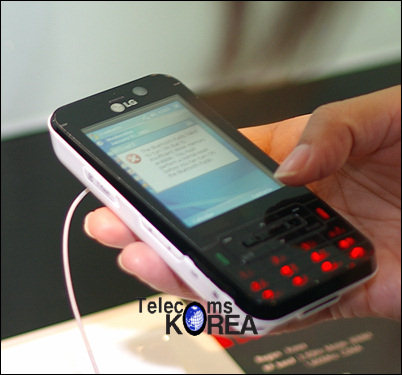
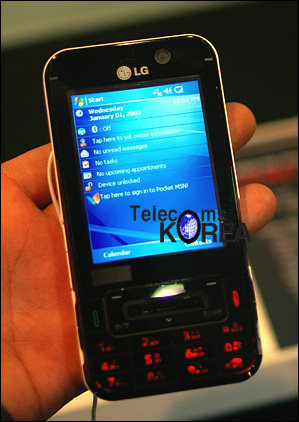
LG recently presented in Korea its brand new smartphone known as the LG-KC1; Moblie Wimax compatible, featuring a 2.8 inches touchscreen and a rather nice design...it also comes equipped with a 2MPx sensor, BlueTooth, Audio/Video player, DMB, 512MB, microSD and other things to make it an excellent all-around product.


Intel Ultra Mobile platform 2007

The HTC Shift based on Intel Ultra Mobile platform 2007


Intel® Ultra Mobile platform 2007 is made up of optimized versions of the Intel processor A100 or A110, the Intel 945GU Express Chipset and the Intel ICH7U I/O Controller Hub.


Intel® processor A100 and A110


N800 Nokia Internet Tablet


Nokia N810

  • Same 4.13-nch WVGA (800 x 480), 65k color display as the N800, brightness increased by ~20%
  • GPS with particular focus on the "context sensitive web" via Ovi
  • 2GB internal storage (not including memory cards), ships with maps for use with GPS
  • Has WiFi (802.11b/g), does not have WiMAX
  • Bluetooth (2.0+ EDR) DUNs to capable phones, totally Foleo-like
  • 400MHz OMAP 2420 CPU, 128MB RAM, 256MB ROM
  • Integrated frontal camera, ambient light sensor, mini USB 2.0, hardware lock switch
  • Plays back video: 3GP, AVI, H.263, H.264, MP4, ASF, WMV, MPEG-1/4, Real video; audio: MP3, WMA, AAC, AMR, AWB, M4A, MP2, Real audio, WAV
  • Battery life aimed at 4 hours of "typical use" (movies, music, internet access, etc.), 10 hours music only, and up to 2 weeks totally idle time, and 5 days active standby ("improved compared to previous generation devices")
  • Runs Nokia's Linux Maemo interface (duh)
  • 5 x 2.83 x 0.55-inches, 7.97 ounces
  • Ships in November, $479


Samsung SPH-P9000

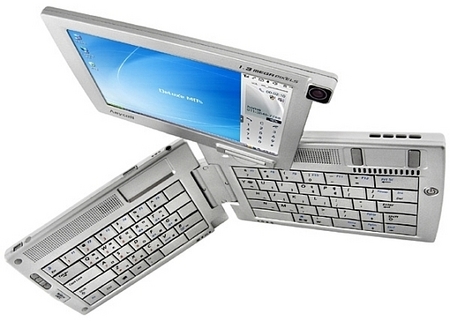
Samsung just busted the entire planet with their latest toy! If you thought Sony had something cool with their UX90, well, think again! Here’s the SPH-P9000 Deluxe MITs, a PC shaped like a PDA, with Windows XP, a 30GB hard disk, 256MB of RAM, a 5” display, a 1GHz CPU, WiMAX, CDMA EV-DO, and a 1.3Mpix camera. It measures 143x94x29mm and weights 580g.


Samsung SPH-M8100 CDMA Phone

Applications such as the push-to-all technology will also be demonstrated. In addition, Samsung's new Mobile WiMAX devices, the Samsung SPH-M8100 will be used at the demonstration, allowing visitors to personally experience Mobile WiMAX technology. The Samsung M8100 is the first commercially available Mobile WiMAX PDA device. A pioneer in Mobile WiMAX technology, Samsung has been conducting numerous trials with various partners in North and South America, Europe, Asia and the Middle East. Currently, seven trials are underway, with more planned in this year. Periodic demonstrations have also been conducted.

  • Standard: CDMA2000 1X EV-DO (1900MHz)Mobile WiMAX
  • Operating System: Windows Mobile 5.0 PPC PE
  • Camera: 2 Megapixel Camera
  • Display: 65536 Color TFT Screen (2.8" 240x320)
  • Features: Mobile TV: Terrestrial DMB
  • Multi-Format Music & Video Support
  • Bluetooth Stereo Music Profile (A2DP)
  • Bluetooth / USB
  • Digital Power Amp
  • MS Office View & Edit
  • Memory: ROM 128MB / RAM 64MB
  • External Memory: MMC micro
  • Size: 143 x 92 x 29.7 mm
  • Weight: 560 g


ZyXel WiMax CPEs


IEEE 802.16e-2005 WiMAX Air Interface (TDD SOFDMA)2.5GHz (MAX-200M1), 3.5GHz (MAX-210M1) and 2.3GHz (MAX-230M1)High Transmit Power (27dBm), 6dBi Built in Antenna, and External Antenna Option
AAS Beamforming Smart Antenna Support
Enhanced Security for Authentication and Ciphering
Local and Remote Control and SW Upgrade Capabilities
Reference standard: IEEE 802.16e-2005 SOFDMA
Radio Access Method: TDD
Frequency:

2.500-2.700GHz (MAX-100)
3.400-3.600GHz (MAX-110)
2.300-2.400GHz (MAX-130)
Channel Bandwidth / FFT size: 5MHz / 512FFT, 8.75MHz/1024 FFT and 10MHz/1024FFT (software selectable)
Central frequency resolution: 125kHz
Modulation: QPSK, 16QAM, 64QAM (DL only)
FEC: CC (Convolutional Coding), CTC (Convolutional Turbo Code)
Smart antenna: AAS according to WiMAX Forum Profile
Maximum output power at antenna port: 23dBm ±1d
Antenna: 2dBi omni, 65ยบ beam width
Up to 5 Mbps downlink, 2 Mbps uplink for user data
QoS management based on classification
Security: EAP-TTLS/CHAP-based user authentication, CMAC message authentication, CCM mode 128-bit AES data ciphering
Max power consumption: 2W


IEEE 802.16e-2005 WiMAX Air Interface (TDD SOFDMA)
2.5GHz (MAX-200M1), 3.5GHz (MAX-210M1) and 2.3GHz (MAX-230M1)
High Transmit Power (27dBm), 6dBi Built in Antenna, and External Antenna Option
AAS Beamforming Smart Antenna Support
Enhanced Security for Authentication and Ciphering
Local and Remote Control and SW Upgrade Capabilities
One Analog Phone Connection for SIP (RFC3261) VoIP
One Ethernet Plug with Advanced Embedded IP Networking Features


Samsung Mobile WiMAX UMPC

SEOUL, Korea - Samsung Electronics unveiled its compact UMPC 'Deluxe MITs(model: SPH-P9200)' at the Samsung 4G Forum 2007 in Korea market. As a successor model of SPH-P9000, it can connect to wireless internet and VoIP phone via Mobile WiMax. Running on Windows XP, the SPH-P9200 adopts 5-inch touch screen, folding QWERTY keyboard and 30GB HDD.


Intel WiMax concept pc
Intel presented a 12-inch concept pc featuring WiMax and ergonomic multi-modal design during Computex Taipei 2007.


Gemtek to present its WiMAX pc card
Gemtek presented its WiMAX pc card 'WIXS-140' during Computex 2007.


SparkLan to present ‘WiMAX Outdoor CPE’

SparklLan presented its 'WiMAX Outdoor CPE' that adopted 20dBm output power and 16dBi antenna.


LG-Nortel to present its WiMAX video phone

HANNOVER, Germany - LG-Nortel presented its WiMAX video phone during CeBIT 2007, which supports IEEE802.16e.


Samsung SGH-P210

Samsung Electronics presented its dual mode handset 'SGH-P210' during CeBIT 2007, which is based on UMA(Unlicensed Mobile Access) supporting normal cell phone and WiFi phone simultaneously.